
AI in Hospitality Interior Design: The Pros, the Cons, and Finding the Right Balance
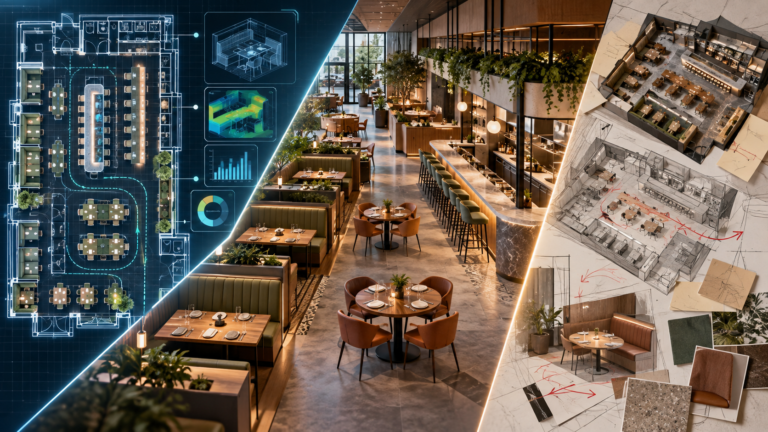
Artificial intelligence is changing the way we work, and hospitality interior design is no exception. From generating photorealistic renderings in seconds to exploring design concepts that might otherwise take hours to develop, AI is opening new doors for designers, architects, and the businesses they support.
But as these tools become more accessible, an important question emerges: How much of hospitality interior design can—and should—we hand over to AI?
The answer isn’t as simple as embracing the technology or resisting it. Like any powerful tool, AI offers significant advantages, but it also introduces limitations that designers must understand before incorporating it into their workflows.
The key is knowing where AI adds value, where it falls short, and why experienced design professionals remain essential to the process.
The Pros: Where AI Is Changing the Game
1. Faster Concept Development and Visualization
One of AI’s most exciting applications in hospitality interior design is its ability to generate visual concepts quickly. Designers can explore different color palettes, materials, lighting conditions, furniture arrangements, and overall aesthetics in a fraction of the time traditionally required.
Need to visualize a warm, modern restaurant with natural wood finishes? Curious how a bold color palette might transform a coffee shop? AI can help bring those ideas to life almost immediately.
This speed allows designers to explore more possibilities early in the design process, helping clients communicate their preferences and make informed decisions sooner.
The benefit: More time exploring creative directions and less time spent producing preliminary visuals.
However, these images should be treated as conceptual tools rather than construction-ready representations. A beautiful image doesn’t necessarily reflect accurate dimensions, available products, installation requirements, or real-world conditions.
2. Improved Efficiency and Productivity
Hospitality interior design involves much more than selecting finishes and creating attractive spaces. Designers manage specifications, coordinate furniture and fixtures, prepare documentation, respond to revisions, and work within project schedules and budgets.
AI can assist with repetitive or time-consuming tasks, including organizing information, drafting preliminary descriptions, summarizing project requirements, brainstorming alternatives, and helping establish initial design directions.
When used appropriately, these capabilities can reduce administrative burdens and give designers more time to focus on the technical and creative aspects of their work.
The benefit: AI can help streamline workflows, allowing design teams to work more efficiently without sacrificing the expertise needed to deliver a successful project.
The greatest gains occur when AI is integrated into a well-defined process, with designers reviewing its output rather than accepting it without question.
3. Expanded Creativity and Design Exploration
AI can be an excellent brainstorming partner. It can introduce unexpected combinations of colors, textures, materials, and design styles that might not immediately come to mind.
For hospitality environments, this can be particularly useful when developing a distinctive brand experience, exploring a new prototype, or creating a fresh interpretation of an established design concept.
AI can help designers push beyond their initial ideas and consider alternatives they might not otherwise have explored.
The benefit: More opportunities for experimentation and creative discovery.
Still, generating ideas is only one part of the design process. An experienced designer must determine which concepts support the brand, function within the space, meet the project’s requirements, and make sense financially.
4. Stronger Client Communication
Not every client can interpret a floor plan, understand a finish schedule, or visualize how individual materials will work together in a completed space.
AI-assisted imagery can help bridge that communication gap by making abstract concepts easier to understand.
For restaurants, retail stores, hospitality spaces, and other hospitality environments, compelling visuals can help stakeholders discuss the intended atmosphere, evaluate design directions, and align on a shared vision.
The benefit: Better visual communication can lead to more productive conversations and clearer expectations.
The important distinction is transparency. Clients should understand whether an image represents an actual proposed design, a conceptual rendering, or an AI-generated illustration. Misrepresenting a conceptual image as an accurate depiction of the finished project can create confusion and unrealistic expectations.
The Cons: Where AI Falls Short
1. A Beautiful Image Doesn’t Equal a Buildable Design
This may be the most important limitation of AI in hospitality interior design.
AI-generated imagery can produce spaces that look incredible but ignore the realities of construction and installation. Furniture may have unrealistic proportions. Materials may appear seamless despite requiring joints or transitions. Lighting may look dramatic without accounting for fixture placement, electrical requirements, or actual light output.
A rendering might show an attractive banquette, but can that seating be manufactured to the dimensions shown? Does the table provide adequate clearance? Can the selected finish withstand the demands of a high-traffic environment?
These are not minor details. They directly affect cost, functionality, safety, and the success of the finished space.
AI can create the appearance of a solution without providing the technical information required to execute it.
Hospitality interior design requires more than visual appeal. It requires translating ideas into coordinated, dimensionally accurate, and practical solutions.
2. Limited Understanding of Real-World Conditions
Hospitality projects rarely happen in a perfect environment.
Existing buildings have structural limitations, irregular walls, fixed mechanical systems, varying ceiling heights, and conditions that may not become apparent until a site is measured or construction begins.
Remodels introduce even more complexity. Existing cabinetry may need to remain in place. New finishes may have to coordinate with materials that cannot be replaced. Furniture and equipment must fit within established constraints.
AI cannot reliably account for conditions it has not been given—and even when detailed information is supplied, its output still requires professional verification.
A concept that works beautifully in a newly constructed space may be completely impractical for an existing restaurant or retail location.
AI does not replace the need for accurate field measurements, existing-condition documentation, site surveys, or professional coordination.
Good design begins with understanding the space that actually exists, not the space an algorithm imagines.

3. Accuracy, Product Specifications, and Material Limitations
Hospitality interior designers must work with real products, approved finishes, manufacturer specifications, and project-specific performance requirements.
AI-generated images can depict materials that don’t exist, combine incompatible products, or present a recognizable finish in a way that differs significantly from the actual material.
An image might suggest a particular upholstery, countertop, wallcovering, or flooring product without identifying a valid manufacturer or confirming its availability.
Even when the product exists, the visual representation may not accurately reflect its color, texture, scale, durability, maintenance requirements, or performance characteristics.
Hospitality spaces may also have specific requirements related to fire performance, accessibility, cleanability, and other applicable codes and standards.
AI-generated content must never be treated as a substitute for verified product data, manufacturer documentation, or applicable code review.
A material that looks right in a rendering is not automatically the right material for the application.
4. The Risk of Losing Design Intent and Brand Identity
Hospitality interior design often involves translating a brand’s identity into a physical environment.
A restaurant, coffee shop, hotel, or retail chain may have established standards for finishes, colors, graphics, furniture, lighting, and customer experience. These elements must work together to create a recognizable and consistent environment.
AI can generate attractive designs, but it may overlook subtle brand requirements, approved design standards, operational priorities, or the reasoning behind established decisions.
It can also produce concepts that look generic or rely heavily on familiar visual trends.
AI can imitate a visual style, but it does not automatically understand the strategic intent behind a brand’s design standards.
Maintaining brand consistency requires human oversight, a clear understanding of the brand, and disciplined review of every design decision.
5. Privacy, Intellectual Property, and Responsible Use
AI tools introduce important questions about how design information is stored, processed, and used.
Hospitality interior designers may work with confidential prototypes, unreleased brand concepts, proprietary drawings, client information, and vendor documentation. Uploading these materials to an AI platform without reviewing its data policies could create unnecessary risks.
There are also questions surrounding copyright, ownership, and the permitted use of generated imagery, particularly when AI tools are trained on or reproduce elements resembling existing creative work.
Design teams need clear guidelines for selecting AI tools, protecting confidential information, verifying usage rights, and maintaining ownership and control of their work.
Responsible AI use begins with understanding the technology—not simply knowing how to operate it.
The Human Element: What AI Cannot Replace
For all its capabilities, AI does not eliminate the need for experienced hospitality interior designers.
Design is a process of balancing competing priorities. A space must look right, function properly, support the client’s goals, fit the budget, accommodate the people who use it, and be practical to build and maintain.
That balance requires judgment developed through experience.
It requires understanding how people move through a restaurant, how customers interact with a service counter, how furniture performs under heavy daily use, and how a design decision in one area can affect operations somewhere else.
It also requires collaboration. Designers work with clients, architects, contractors, manufacturers, vendors, and internal teams to resolve problems and make decisions that cannot always be anticipated at the beginning of a project.
AI can assist with generating possibilities, but experienced professionals must evaluate those possibilities against the realities of the project.
Technology can accelerate the design process, but expertise determines whether the result is successful.
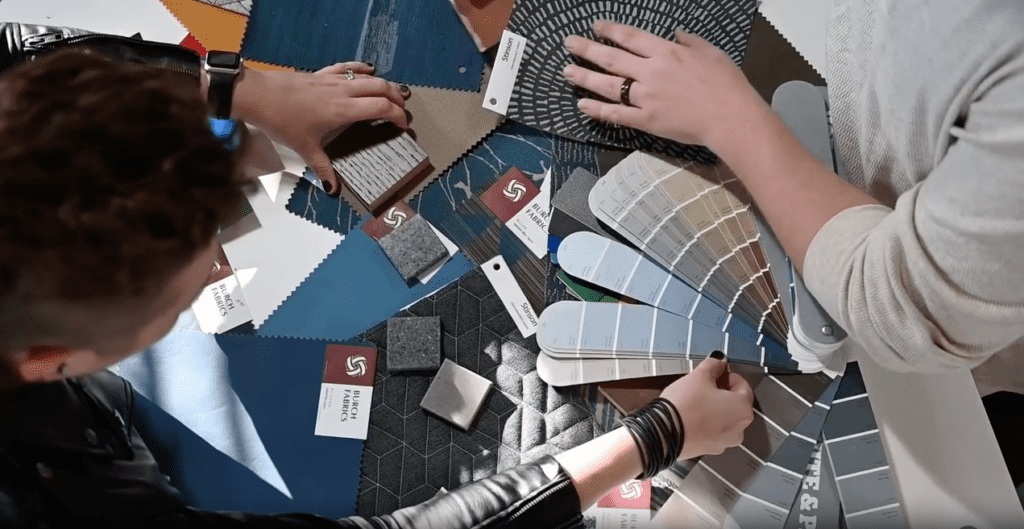
Finding the Right Balance: AI as a Design Partner
The most effective approach is not to choose between AI and traditional design methods. It is to understand how the two can complement one another.
AI is well suited to tasks such as:
- Exploring preliminary design concepts and visual directions.
- Generating inspiration for color palettes, materials, and aesthetics.
- Creating conceptual imagery for early client discussions.
- Assisting with repetitive administrative tasks and information organization.
- Supporting brainstorming and the exploration of design alternatives.
Human designers must remain responsible for:
- Verifying dimensions and existing site conditions.
- Developing accurate floor plans, elevations, and construction documentation.
- Selecting actual products and confirming their specifications.
- Coordinating with architects, engineers, contractors, and vendors.
- Evaluating functionality, accessibility, safety, and applicable code requirements.
- Maintaining brand standards and design intent.
- Reviewing final deliverables for accuracy, feasibility, and quality.
Organizations should also establish clear policies for confidentiality, client disclosure, human review, and the acceptable use of AI-generated materials.
The goal should not be to use AI everywhere. It should be to use it where it provides measurable value without compromising the integrity of the design process.
Looking Ahead: The Future of Hospitality Interior Design
AI will continue to evolve, and its role in hospitality interior design will likely expand. As tools become more sophisticated, they may offer stronger integration with modeling software, product libraries, documentation systems, and project coordination workflows.
Design teams that learn to use these tools thoughtfully may gain advantages in speed, communication, and creative exploration.
But the fundamentals of good hospitality design will remain.
Successful spaces must respond to real people, real buildings, real budgets, and real operational demands. They must be more than attractive images on a screen.
The future belongs to designers who can combine technological innovation with technical knowledge, creative thinking, practical experience, and sound professional judgment.
Final Thoughts
AI is neither the enemy of hospitality interior design nor a complete solution to its challenges. It is a tool with tremendous potential—and meaningful limitations.
Used strategically, it can help designers work smarter, explore ideas faster, and communicate more effectively. Used without proper oversight, it can introduce inaccuracies, unrealistic expectations, and costly mistakes.
The distinction lies in the expertise behind the technology.
AI can help us imagine what a space could be. It takes experienced designers to determine what it should be—and how to make it happen.